





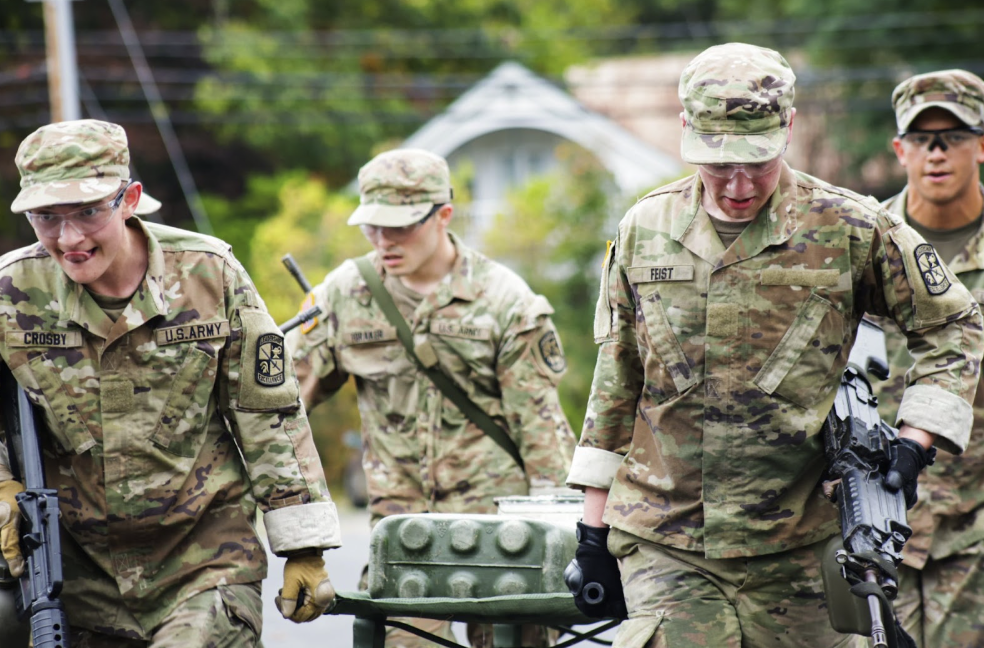
A storied part of the Corps of Cadets’ history and culture, the various specialty units here at Norwich University have had a rough start to the semester. They’ve faced everything from delays to the beginning of their new-member training, restructuring of their training models, and even outright disbandment for some.
Specialty Units are small, tight-knit, ROTC-sponsored organizations that focus on providing advanced training to students who elect to participate in them. Until this year, seven total units administered specialized training in different military fields: Norwich Ranger Company, Mountain Cold Weather Company (MCW), Norwich Artillery Battery (NAB), Semper Fidelis Society, Semper Fortis Society, Semper Paratus Society, and Arnold Air Society.
In addition to being completely voluntary, these units are run by and for cadets as well as overseen by the ROTC staff. Typically, the process to become a member of one of these groups requires one to two semesters of intense physical training as well as many physical fitness and knowledge tests that cadets of any class-year can go out for.
During the first weeks of the school year, Norwich Specialty units begin their annual training. This year, however, a new direction came from US Army Colonel Jason Dudley, the new Professor of Military Science in charge of the Army ROTC Department. A temporary pause on most training activities was put in place in the beginning of the school year, which directly affected the three Army-based specialty units: MCW, NAB, and Norwich Ranger Company.
“…due to nothing more than my desire to seek additional clarification and education about what my role as a mentor entailed, and ensure I was endorsing, resourcing, and supervising training that had a direct link to Army programs of instruction and provided skills to Cadets that would be beneficial to their role as future Army officers,” according to COL Dudley, from an email statement to the Guidon last week. “I implemented this pause to ensure as a club mentor I was endorsing training that was grounded in first principles, Army values, and Army skills & drills.”
COL Dudley insisted the changes in place were to ensure the longevity of these Specialty Units and that the training reflected and maintained their esteemed reputation. “ My intent is to protect the legitimacy and longevity of these clubs in perpetuity… I’m trying to ensure I am the best mentor possible, and am in a position to assist these clubs thrive at Norwich.”
Norwich University’s Arnold Air Society—the Lt. Col Earle Kelly Squadron—faces much bigger changes. Due to new guidance and restrictions on new member candidacy training from Arnold Air National Staff and a bigger focus on community service, the Norwich chapter of the organization has opted to separate itself from the Arnold Air Society namesake. The current members of the Kelly Squadron formed a new organization, “The Norwich University Combat Rescue Squadron”.
We reached out to US Air Force Colonel Kelly Burt, the Norwich Air Force ROTC Detachment Commander, a University of Nebraska Arnold Air alum, for comment on the changes. “This specialty unit will function in a manner consistent with the other traditional Norwich University-based specialty units… its candidacy model will closely resemble the program that the Kelly Squadron has used up until now.” COL Burt stated via email correspondence. “This change will be permanent. While the Arnold Air Society and the Kelly Squadron may be revived at Norwich in the future, the squadron will be separate and distinct from the new specialty unit.”
COL Burt stated his support for Arnold Air National Staff’s renewed emphasis on community service, but sees great value in the expeditionary tactics and warfighter knowledge that are the focus of Kelly Squadron training. “ I am excited to see this training live on through a new Norwich specialty unit!”, said Burt at the end of his statement.
This past Monday, MCW, NAB, Norwich Ranger Company, and the new Norwich University Rescue Squadron began their new member training under the new oversight, ending the temporary pause placed on these units. This marks the beginning of new member training for these specialty units, which are typically two hours in the afternoon from 4:00 p.m. to 6:00 pm, or an hour-long morning training, starting at 5:15 a.m. The training is typically every day during the first week, before dropping to a smaller amount. The training ends typically near the end of a semester, with a culminating event: a multiple-hour-long event that tests the new members’ knowledge, endurance, and fitness.
While a majority of the other units are essentially back to full-time operation, the Semper Fidelis Society, Semper Fortis Society, and Semper Paratus Society at Norwich are not as fortunate. Although most people on campus refer to these organizations as specialty units, their status as such is technically unofficial, only being recognized as student clubs since they lack an ROTC advisor. This does not allow them to run a candidacy program like the other specialty units, override Rook training times, or have strict attendance policies about meetings. Because of this, the Semper Fortis and Semper Paratus Society have disbanded.
However, the Semper Fidelis Society is not going to disband just yet. With its original members, they will host their annual “Walter Levy Challenge” in honor of Norwich Alum, Walter N. Levy. We spoke with Jared Stevens, a member of the Semper Fidelis society, and he spoke about the organization and its event.
“Semper Fi will stay open until we finish the Walter Levy Challenge.” Stevens began, “Then we will officially disband after the challenge and donate most of the funds to the Semper Fi & America’s Fund.” The Walter Levy Challenge will take place tomorrow morning with an information meeting at 8:30 a.m. and the race starting at 9:00 a.m.
Norwich’s Specialty Units are a staple of the traditions of the Corps of Cadets. As rooted in those traditions as they may be, these changes bring accountability to cadet leaders to ensure their training has value. The changes force these Specialty Units to adapt and grow with the world, as well as a new era of Norwich Leadership.